Porous City Exhibition and Debate

05 March 2013

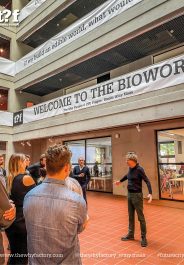
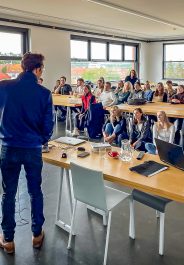
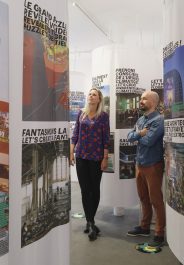
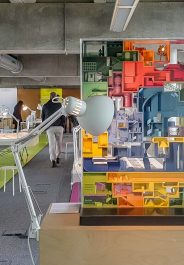
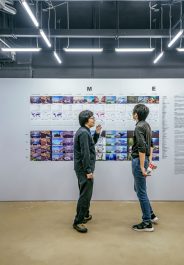
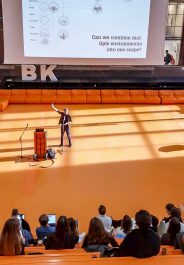
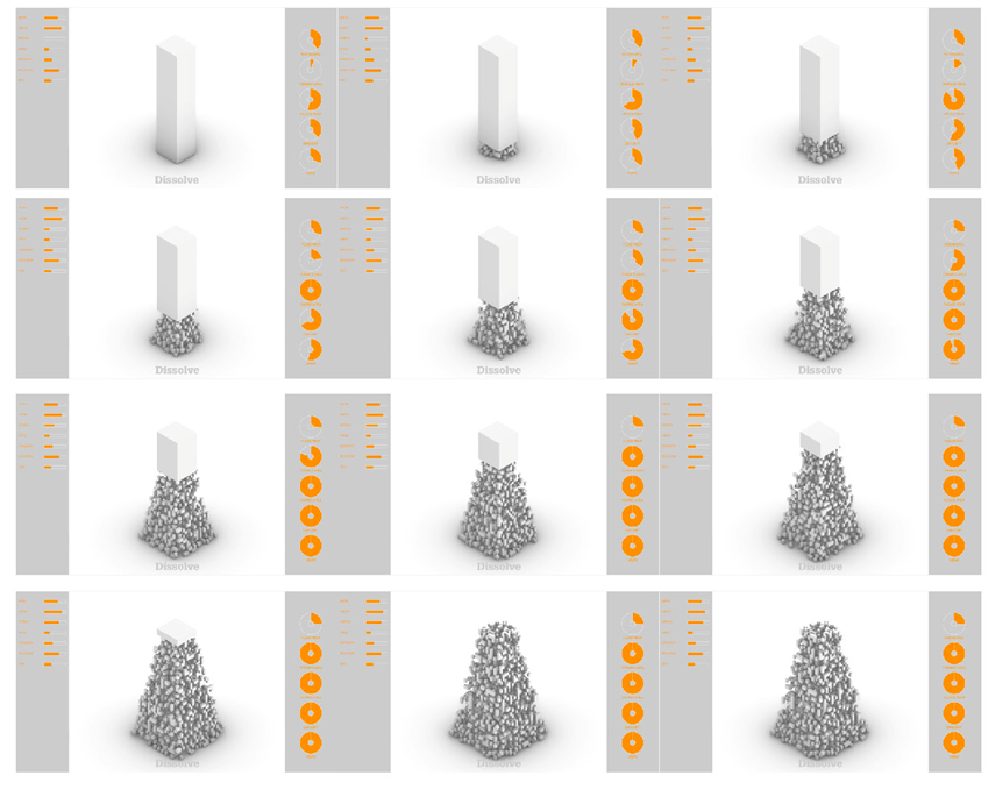
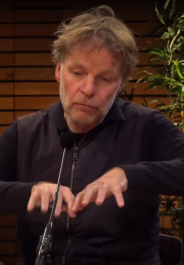
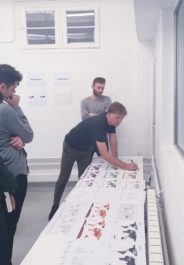
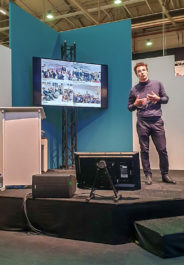
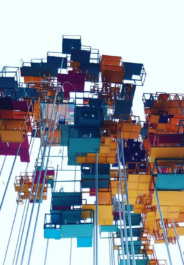
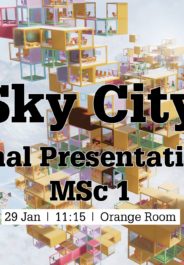
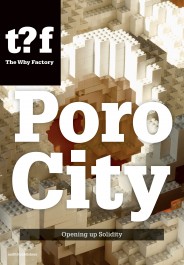
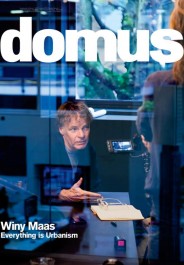
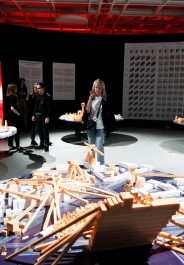
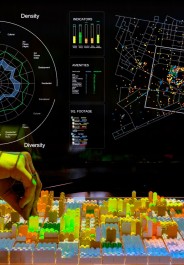
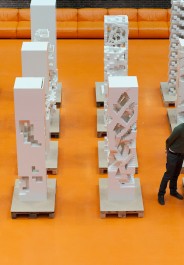
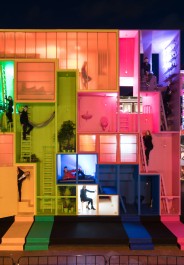
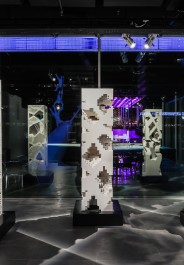
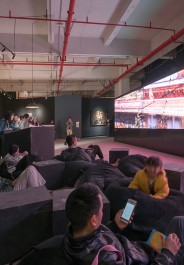
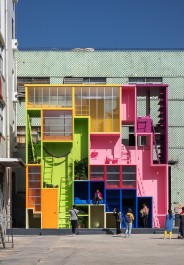
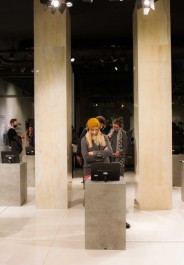
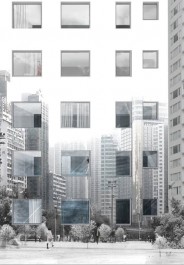
  On 5-15 March 2013 T?F showed the results of the Msc1/2 studio research on applications of porosity to urbanism. The exhibition was followed by a debate on the implications and benefits of a porous structure for the city. With Taeke de Jong, Han Meyer, Winy Maas and Alexander Sverdlov.

images by Frans Parthesius ©


MVRDV and The Why Factory at BODW Hong Kong: Porous City made of 1.5 million LEGO bricks

02 December 2012

MVRDV and The Why Factory in collaboration with the Hong Kong Design Center (HKDC) will present ‘Porous City’ at the 10th edition of BODW, Hong Kong’s annual Business of Design Week. Addressing the evolution of the skyscraper in the Asian context, BODW will showcase 9 LEGO® towers completed this year at the TU Delft and another 101, which students of Hong Kong universities and practicing architects will produce during a workshop run by MVRDV and The Why Factory during BODW. Porous City will be discussed further by Winy Maas during the BODW Forum.

Entitled ‘Porous City’, MVRDV and The Why Factory (T?F) present their ongoing research on the design of skyscrapers and the potential of porosity as a European approach to urban density. The results are presented as scale models made of LEGO bricks, recently exhibited at the 13th Venice Architecture Biennale. During BODW, researcher and lecturer Tihamér Salij with researcher Ania Molenda from The Why Factory will run the 4-day workshop ‘Porous City: Opening up the Tower’ with 20 students from Hong Kong Polytechnic University and City University of Hong Kong as well as 10 practicing architects from Hong Kong Design Institute and invited critics to develop the study further within the Asian context. The results of this workshop, 101 LEGO towers at a scale of 1:1000 will complement the exhibition of 9 large towers, which represent the outcome of the earlier design studio  ‘Eurohigh’ at Delft University of Technology, Netherlands, a collaborative project by T?F and KRADS. 
 
Winy Maas, Principle Director MVRDV and Founder of The Why Factory will discuss Porous City on 7 December at 11:30 – 12:10 during BODW Forum and at 3pm during a review of the workshop at the Hong Kong Convention and Exhibition Center. The BODW Forum is a 3-day event of lectures by global leaders on subjects ranging from design and culture to branding and communication.

The workshop ‘Porous City: Opening up the Tower’ takes place at the InnoCenter, 72 Tat Chee Avenue, Kowloon Tong Kowloon, Hong Kong, 30 November to 3 December. From 6 to 8 December, Hong Kong Convention and Exhibition Center (HKCEC), 1 Expo Drive, Wanchai, will host the exhibition ‘Porous City’ in Hall 3D-E, and BODW Forum in Hall 3G.

The ‘Porous City’ showcase has been generously supported by LEGO Group, Denmark, the Netherlands Architecture Fund, the Netherlands Consulate General in Hong Kong, Project A limited (Art + Culture + Design + Education), Philips and the Hong Kong Design Center (HKDC).
 
BODW has been organized annually by the Hong Kong Design Center since 2002, each year inviting leaders in fields of design, business, fashion and technology to discuss and share ideas through conferences, forums and exhibitions. The 10th edition of BODW will take place from 3 through 8 December 2012, with collateral events, such as DETOUR 2012, from 30 November through 16 December.


City Shock: The Why Factory's 6th book comes out next Friday

28 September 2012

Next Friday (October 5th, 16:00-17:30) The Why Factory will present its 6th book in the Future Cities series titled City Shock. 

City Shock shows the world where forecasting seems futile, where predictions are unreliable, and where even the most absurd scenarios are plausible, where many urban planning decisions seem to be governed not by vision – but by fear. Fear of disaster, fear of change, fear of the unknown.

The book asks if we could learn from ‘fear’ or maybe even use it as a guide for spatial planning? It explores ten innocent ‘what ifs’ by looking at different kinds of radical trend breaks we could potentially expect and the effects they could trigger.
Guided by fantasy rather than science, this book imagines how each of these scenarios could play out in the Dutch landscape between 2018 and 2047. In a narrative composed of (im)possible headlines, a chain of fictitious newspaper spreads reports these events, exposes their possible causes and depicts their potential consequences for Dutch spatial planning and lifestyle.

The presentation of the book will be followed by a roundtable discussion with Henk Ovink and Winy Maas moderated by Felix Madrazo on the ability of planning as a spatial practice to react to the unexpected in our current environment within the context of Europe and The Netherlands.

City Shock is the sixth book in the Why Factory's Future Cities series after Visionary Cities, The Why Factor(y) and the Future City, Green Dream, Vertical Village and Hong Kong Fantasies.

Program:
16:00-17:00 Presentation of City Shock by Winy Maas and Felix Madrazo
17:00-17:30 Roundtable discussion with Henk Ovink and Winy Maas moderated by Felix Madrazo
17:30 Drinks

Location: Oostserre / Faculty of Architecture / TU Delft. 


The Why Factory’s first contribution to the Venice Architecture Biennale, presenting Europe’s qualities and anarchistic urbanism

15 August 2012

This year The Why Factory will participate to the Architecture Venice Biennale for the first time. It will contribute to two events, which will be part of the Common Grounds exhibition curated by Sir David Chipperfield. - Together with EFAP The Why Factory will launch EU City Program, a manifestation representing Europe for the first time at the Venice Architecture Biennale. With MVRDV it will present a collaborative project ‘Freeland’ to be shown in the Central Pavilion at the Giardini.

EU City Program – A Manifesto:
Architecture deserves a strong role in European public policies. To strengthen the role it can play in the sustainable, economic and social development of Europe, the European Forum for Architecture Policies (EFAP) teamed up with The Why Factory to initiate the EU City Program. – A ground-breaking series of research projects on the future of Europe.

The EU City Program will be launched at the Opening Conference of the Venice Architecture Biennale, hosted by the President of the Biennale, Mr. Paolo Baratta and the curator of the 13th Architecture Venice Biennale Sir David Chipperfield. In the presence of European authorities, mayors and architects, Winy Maas (MVRDV/The Why Factory) will present the EU City Program, including studies on heritage, population density, economy, landscape, energy, resilience and monitoring in Europe.

An on-going study by The Why Factory titled Porous City will be exhibited at Spazio Punch at Guidecca to exemplify the research approach presented in the EU City Program. The exhibition will present a collection of 676 scale models made of one million LEGO® bricks, that display an extensive catalogue of qualities and potentials of porosity as a European way to urban density.

Freeland:
MVRDV and The Why Factory will exhibit a collaborative project ‘Freeland’. Presented as an animated documentary on a multi-screen surround projection, Freeland explores the prospects of complete liberation of urban planning. It questions whether classical centralized planning is still needed in times of increased individualization and if instead a self-organized city can be imagined. What can be organized individually and when will we need our neighbours? What are the “minimal common grounds” of our developments?

Furthermore The Why Factory will also present the latest AnarCity research developed in collaboration with the Berlage Institute in Rotterdam earlier this year. It is a utopian scenario which takes the idea of bottom-up urbanism to the extreme and presents it against the backdrop of the European city.

‘Freeland’ is a collaborative project by MVRDV and The Why Factory and was made possible by the financial support of the City of Almere. Rotterdam based SYNPLE made the animation. The Porous City showcase has been developed by The Why Factory in collaboration with KRADS, and supported by the LEGO Group.   

The launch of the EU City program will take place on Monday, 27 August at the opening of the 13th Architecture Biennale.
The exhibition Porous City will be opened on Sunday, 26 August at 18.00 at the Spazio Punch, Giudecca 800/o, Venezia 30133, Italia.

It will be the second time that The Why Factory participates at one of the largest cultural events this year following its participation at the Documenta 13 in Kassel together with MVRDV.

Visit also www.mvrdv.nl and  www.eucitymanifesto.eu


The Why Factory launches a new studio at ETH Zurich

14 August 2012

This semester The Why Factory will for the first time run a design studio at ETH in Zurich. The studio focused on constantly changing and adaptive city titled The Transformer will be led by Winy Maas (Guest Professor), Ulf Hackauf and Adrien Ravon.

Life in the real-time adaptive, constantly changing city
In today’s cities and buildings, we see a growing invasion of ambient technologies. We got used to light turning on when we enter a room, traffic lights adapting during rush hour and autopilots steering jumbo jets. Even the smart fridge that orders food and turns on the oven while suggesting dinner receipts to you became reality and is being launched later this year.

In the Transformable City project, we take this development a step further. The city reacts physically. Buildings can move, expand or shrink. Public space can adapt to different requirements. Spaces can transform to your desires. Your apartment can fluently change from bedroom to bathroom, to lounge or sun deck or shrink and almost disappear if you are not home.

If such an adapting environment becomes reality, how does the user interact with a constantly changing, adapting city and it’s users. If your wall can change into a bed, a window, a bathroom – how do you tell your wall what you want? If the city can adapt to different needs of social interaction or quiet privacy, how does it ask the citizens what they want? How dynamic can the city react if different users have different desires? What images can we expect from a city, which is constantly re-made, re-build by it’s users?

download PDF

Kickoff: Tuesday the 18th of September, Room to be announced.
Exercise Type: E (Entwurf ohne integrierte Disziplin).
Contact: ulf@thewhyfactory.com


The Why Factory receives Zumtobel Award Honorable Mention

05 July 2012

Ulf Hackauf, Pirjo Haikola and Gonzalo Rivas of The Why Factory received an honorable mention in the Zumtobel Group Award for Sustainability and Humanity in the Built Environment, Research & Initiative category with the project Sunny Water Lilies. The jury awarded one first prize and four honorable mentions.

The Sunny Water Lilies is a visionary project that celebrates green infrastructure and advocates beauty, scale and usability. It is a proposal for a solar thermal power plant, which floats on water and generates sustainable electricity for coastal towns and cities. It combines large scale technology with aesthetics. Placed in a delicate natural environment, the project illustrates how sustainable energy generation does not have to hide, but how it can even add to the beauty of nature.

The technologies used in the water lilies are tested on smaller scales (the design refers to a household-sized reflector developed by the American inventor Bill Gross) and on larger scales (the Spanish power plant Andasol using solar thermal technology to generate 180 GWh of electricity per year).

The project was developed as a part of the research published in “Green Dream: How Cities Can Outsmart Nature”, NAi Publishers 2010. The Why Factory plans to use the awarded prize to develop the project further and bring it closer to realization.

The presentation ceremony for the 2012 Zumtobel Group Award will be held in Berlin on 16 November 2012.


“Welcome to the Vertical Village” Exhibition opens in Seoul

27 June 2012

‘Welcome to the Vertical Village’ exhibition opened at Total Museum of Contemporary Art Seoul. In the exhibition visitors walk through a giant model of a possible Vertical Village to experience its spatial richness and three dimensionality. The show by MVRDV and The Why Factory was opened earlier in Taipei and is now in a totally new design at show in Seoul: a city under rapid transformation, the ideal environment to answer to the ‘block attack’ and propose alternatives. The show is open to public between June 20 and October 7 and features films, an outdoor sculpture and a giant vertical village made of more than 700 objects.

Under the title “Welcome to the Vertical Village” the exhibition explores the rapid urban transformation in East Asia, the qualities of urban villages and the potential to realize this in a much denser, vertical way as a radical alternative to the monotonous block architecture with identical standard apartments and its consequences for the city. The exhibition consists of analytical research, various movies, a documentary and animations, two software packages and a 3 meter tall sculpture of a possible Vertical Village developed by MVRDV and The Why Factory. Visitors can design their ideal house and compose their own Vertical Village with parametric software.
Total Museum of Contemporary Art (TMCA) in Seoul had invited MVRDV, The Why Factory and JUT Foundation for Arts and Architecture to move the Vertical Village exhibition to Seoul. The exhibition is developed as a large installation. Visitors experience a walk through a large 1:15 scale model of a vertical village composed of more than 700 objects, turning the museum into a Vertical Village itself.
Outside a model of the Vertical Village is exhibited, which after the show will be shown permanently as a piece or public art at a small plaza in the city centre which is surrounded by grey monolithic buildings, emphasizing the quality of the urban village even more.

Equal Books Publishers Seoul publish the Korean edition of ‘the Vertical Village’ catalogue, with added and updated to the English and Chinese edition. The book contains the ample research made comprehensible with countless colour illustrations. It features detailed case studies for Seoul, Beijing, Shanghai, Taipei, Djakarta, Tokyo and Bangkok, interviews with Winy Maas, Alfredo Brillemburg and Hubert Klumpner, Lieven De Cauter, Peter Trummer and many others.
The exhibition and publication has been made possible with the generous support of ILJIN, JUT Foundation for Arts and Architecture Taipei, Delft University of Technology, The Why Foundation and the Netherlands Architecture Funds.
Total Museum of Contemporary Art (TMCA) is Korea’s first private museum devoted to the art of our time. The TMCA offers various programs of the most thought provoking art in the form of exhibitions, workshops, performances, and lectures. Since its inception, the museum has focused on introducing international contemporary art scenes to Korea and vice versa by inviting many renowned artists like Bernar Venet, Tal Streeter, Bjorn Melhus, Dryden Goodwin, and James Turrell.

The pressure on the East Asian cities has lead to an increasing urbanization and densification during the last decades. It has made way for the construction of giant buildings, mostly towers, blocks and slabs. A ‘Block Attack’ that gradually replaces and scrapes away the more traditional low rise, small scale, often ‘lighter’ types of architecture and urbanism: the Hutong in Beijing, the small wooden houses in Tokyo, the villages in Singapore, the individual houses in Taipei, and in Seoul and other East Asian cities.


These urban villages form mostly intense and socially highly connected communities, with enormous individual identities and differentiations. One can speak of urban ecologies, communities that have evolved over the course of centuries. Their rapid, faceless replacements by large scale monolithic blocks, packed with identical apartment units offer a Western standard of living at an affordable price, but at the expense of differentiation, flexibility and individual expression.
Is there an alternative to this process? Can one imagine a new model for the development of East Asian cities? Can these areas be densified in such a way that the qualities of the traditional village are preserved? The Vertical Village is proposed as an contemporary alternative– a three-dimensional community that brings personal freedom, diversity, flexibility and neighbourhood life back into East Asian – and maybe even Western – cities.


MAY 29th THE PIXEL POWER - Lecture & debate by Winy Maas and Rob Nijsse On porosity, pixels and LEGO

23 May 2012

The Why Factory invites everyone to a lecture by Winy Maas and Rob Nijsse entitled ‘The Pixel Power’. The event will take place on May 29th (16:30-20:00) at the Faculty of Architecture in Delft, at the orange tribune in the Oostserre. It will be inaugurated with an introduction about the ‘Opening the Tower’ exhibition and followed by two lectures and a debate. The debate will revolve around the systematic of pixelization being a design/scripting tool. This event is open to public and free of admission.

Program:
16:30 Introduction - reflections on the porosity and LEGO as a design tool
17:00 “Pixel Power” lecture by Winy Maas
17.30 “Pixelated Structures” by Rob Nijsse
18:00 Debate moderated by Alexander Sverdlov
18:30 Drinks

The event is part of ‘Opening the Tower’ exhibition - open from May 16th until June 5th 2012 at the Faculty of Architecture in Delft.

‘Opening the Tower’ exhibition can be seen at the Faculty of Architecture TU Delft from the 16th of May until the 5th of June 2012. ‘Opening the Tower’ presents two sets of experiments exploring different aspects of porosity on two significantly different scales. Built with approximately one million white LEGO bricks – 676 towers on scale 1:1000 and 16 towers on scale 1:100 investigate development of possible new relationships between mass and void in large-scale architecture. The material presented at the exhibition is a result of design studio led by The Why Factory through fall semester 2011/12. The studio was developed and supervised by Prof. Winy Maas, Alexander Sverdlov and Ania Molenda in collaboration with KRADS and support from LEGO and Arup.


New studios for fall semester 2012

11 May 2012

The enrollment period for fall semester 2012 starts already next week. It will take place from the14th until the 25th of May.

In the coming fall, The Why Factory will run a number of studios based on ongoing as well as new topics. For the MSc1 and MSc2, this will be:

4 min City detail - Buildings and details for the city of speed,

Porous City - Explorations on porosity with LEGO as a modeling tool,

BiodiverCity House - Designing biodiverse individual living environments,

Food City - Strategy and Typologies for a closed-cycle Food Metropolis.

We will also offer two topics for the Actualities workshop:
‘1 Million Balconies’ will be an excursion workshop, which will take place at the Helsinki Design Week. The second workshop will be organized at TU Delft and its theme will be announced shortly.

Based on these topics, we are currently developing the precise studio briefs. We will present these at the beginning of the fall semester to all students enrolled at the Why Factory. You can then give your first and second preference for the studio topic and we will form the studio groups accordingly.

For the MSc3/4 graduation lab, we invite you to come up with your own proposal.

All course codes can be find in the participation section of this website.


Branding Cities and Bottom-Up Urbanism. Double book-launch on February 14th.

09 February 2012

On the 14th of February the Why Factory will present its two new books:
'Hong Kong Fantasies – Challenging World Class City Standards' by The Why Factory in collaboration with IFoU, Berlage Institute, Chinese University of Hong Kong, Hong Kong University) and 'Vertical Village – Individual, Informal, Intense' by The Why Factory and MVRDV  in collaboration with JUT / Museum of Tomorrow and Berlage Institute.

On the occasion of this book launch, Prof. Winy Maas will discuss the issues addressed in both publications with  Leendert Bikker (Economic Development Board Rotterdam), Vedran Mimica (Berlage-Institute), Wouter Hagen (VolkerWessels), Wouter Vanstiphout (TU Delft, Crimson architectural historians) under the debate title Branding Cities - and Bottom-Up Urbanism.

Hong Kong Fantasies - Challenging World Class City Standards
What does it take for a city to become world-class? And who decides? It’s not enough to look at a city’s economic performance. Great cities have always offered a more fundamental, abstract quality – a quality that no single ranking system has yet been able to measure. This book tries to define that quality, and to introduce a universal standard for its evaluation: The World-Class City Framework – WCCF. The Why Factory fantasizes that Hong Kong, a city struggling to hold on to its reputation, makes a spectacular comeback as an exemplary world-class city.

Vertical Village - Individual, Informal, Intense
For centuries, the fabric of East Asian cities has been formed by urban villages that are built up of small scale, informal, often ‘light’ architecture. These urban villages form intense, socially connected communities where strong individual identities and differences are maintained. Driven by demographic and economic forces, these cities are now rapidly changing. Massive towers, slabs and blocks with repetitive housing units, floor plans and façades are scraping away the urban villages that have evolved over hundreds of years. The Vertical Village proposes an alternative to this growing monotonous sea of blocks. In the Vertical Village, a planning software is proposed which supports the evolutionary bottom-up grow of the villages in a dynamic way as no masterplan could provide it.

14 February 2012 | 18:00 - 20:00
location: BK City, Glasshouse East 


Winy Maas gives speech at European Parliament

13 January 2012


On January 11th Winy Maas spoke at the “Non-City”*... Next City? conference at the European Parliament on “How architecture and urbanism can strengthen Europe?". The conference was organised by the EFAP (European Forum for Architectural Policies) with the Urban Intergroup of the parliament and was a follow-up on the "Non-City" conference, which took place last year at the European Pairlament. The invited speakers included: Prof. Winy Maas, Mr. Jaap Wiedenhoff (ARUP) and Frédérique Monjanel (VINCI). An inspiring discussion between the speakers, experts from European Economic Social Committee, European Investment Bank, METREX, members of the Parliament, European Commission and representatives of the member States was chaired by Jan Olbrycht – the President of the Urban Intergroup.


For the first time, the directors of architecture of the European member states were invited to discuss how architectural policies can take a more active part in the development and the implementation of the European Union set out in the EU 2020 Strategy, especially on European Urban Agenda. Or even to elaborate on a European Urban Policy.
The adoption of the Council Conclusions on architecture and sustainable development in
2008 encouraged a greater attention for architectural and urban diversity and a more flexible city planning. The challenge is to create space for new unconventional approaches, to allow imagination, innovation, creation and non-dogmatic practice.

Good architecture and good cities obviously can lead to better living environments, with more value and attraction. However, it would seem that we witness a greater trivialization instead of diversity and spatial quality in urbanized areas.
Europe is remarkable. The strong points of Europe are overwhelming amount of
various cultures, cities and landscapes, the enormous accessibility, the seemingly endless
Heritage, the high quality of architecture and landscape architecture, the talented designers, the green awareness, the desire for fashion and innovation. How to strengthen that?

The social, demographic, ecological and economic challenges of our present-day society call for a new élan, new visions.

What kind of architectural and urban projects can do that? How to support it? If so, what criteria do we need to develop? What organization can do that? And how to do it in a way that attracts the attention of all Europeans, if not outsiders?
The future European programs on urban and territorial cohesion offer a unique opportunity to allow architectural knowledge to meet these challenges in an open-minded
way. To experiment, untied by suffocating regulations. To design unexpected scenarios. 


Luxury of the North to be presented on November 30 and December 8

23 November 2011

Luxury of the North – the outcome of Droog Lab’s study on survival in Pond Inlet, Nunavut in the Canadian North will be presented at two events in Toronto and Edmonton, Canada in partnership with University of Alberta. XXL City by Cynthia Hathaway will be presented with a discussion and tasting of giant foods at the Gladstone Hotel, Toronto on November 30th, 2011. Arctic Imports by Winy Maas (MVRDV, The Why Factory) with Pirjo Haikola (The Why Factory) and the Productivity of Nature by Christien Meindertsma will be presented at a symposium at University of Alberta, Edmonton on December 8th, 2011. “The aim of the Droog Lab is to see how ways of living in different parts of the world can inspire new directions for the future of design,” says Renny Ramakers, co-founder and director of Droog and initiator of the project. “The Canadian North is known to be harsh. We wanted to see how its extreme qualities might influence new city concepts and urban luxuries elsewhere.”

In Arctic Imports by The Why Factory each of the city concepts – Horizon city, Endless backyard, No noise, No safety and Artificial suns-explore how a quality found in the Arctic might result in a different urban landscape, urban form and architecture. Luxury of the North is part of the Droog Lab series, ‘Here, there, everywhere,’ which investigates how people in daily situations worldwide can inspire new directions for the future of design.

TORONTO: NOV 30
XXL City by Cynthia Hathaway
Discussion and tasting of giant foods with Renny Ramakers (Droog), Cynthia Hathaway, Mark Gorgolewski, Tim Antoniuk (University of Alberta), Agata Jaworska (Droog) and Misha Glouberman (moderator)
Wednesday, November 30th, 2011 7:00 - 9:00pm
Gladstone Hotel, 1214 Queen Street West, Toronto
rsvp: info@droog.com (limited capacity)

EDMONTON: DEC 8
Luxury of the North lectures and panel debate featuring: Here, there, everywhere by Agata Jaworska (Droog), Arctic Imports by Pirjo Haikola (The Why Factory), Productivity of Nature by Christien Meindertsma
Thursday, December 8th, 2011
Lectures & panel debate:
7:00 - 9:00pm
Drinks from: 6:30 – 7:00 pm
& 9:00 – 10:00 pm
Telus Centre, University of Alberta Campus, Edmonton

more information
http://www.droog.com/projects/models/luxury-of-the-north/ 


'Green Talk' with Winy Maas will take place on November 15

11 November 2011

'Green Talk' will take place on November 15 at Perpustakaan Pusat (Central Library), Universitas Indonesia Depok in Djakarta. The event is a part of the 'Green Dream & Visionary Cities' exhibition, which was officially opened last week (November 4). The opening inaugurated Ton van Zeeland (the director of Erasmus Huis), Daliana Suryawinata (curator of the exhibition) and Budi Hardiman (philosopher) was crowdedly attended and very well received.

In the forthcoming 'Green Talk' Winy Maas, Ridwan Kamil, Avianti Armand and Imelda Akmal will discuss the state of green in the world today. The debate will be moderated by Daliana Suryawianata (The Why Factory) who will confront the speakers with questions related to the feasibility of green cities and the importance of their performance.

We would like to cordially invite everyone to participate and take active part in this debate. We hope for not only for an intensive discussion between the very special speakers whom we have invited for this event, but also the audience.

If you would like to participate please reserve tickets beforehand by email: sekretariat.iai@gmail.com (Rp 175,000)

NOTE: a ticket for Public Lecture IAI 15-16 November for Rp 500,000 also includes Green Talk. Please contact sekretariat.iai@gmail.com for reservations.

For more information please visit:
http://publiclecture-iai.webs.com/greentalk.htm

Find the 'Green Talk' event on Facebook:
http://www.facebook.com/event.php?eid=285443304823004 


'Green Dream & Visionary Cities' exhibition opens tomorrow in Jakarta

03 November 2011

'Green Dream & Visionary Cities' exhibition will be shown at the Erasmus Huis in Jakarta for the next three months. It will be officially opened on the 4th of November and remain on display until mid January 2012. The exhibition will present two of the first projects from the 'Future Cities series' by The Why Factory.

The exhibition will be accompanied by a 'Green Talk' debate on November 15 with Winy Maas, Ridwan Kamil, Avianti Armand and Imelda Akmal. This public event aims to bring visionary thinkers in architecture and urbanism together to discuss about the state of green in the world today. – There is confusion about what green means for design, architecture and urbanism. Winy Maas in the well-acclaimed book Green Dream (NAi publisher, 2010) asserts that green projects are still disconnected efforts which fail to attain the scale of the interventions that are actually called for. Green is fashionable, but its design potentials remain unexplored. The discussion will comment on green urban projects and observations of the future. It will address questions related to the feasibility of green cities and the importance of their performance.

Green Dream & Visionary Cities
Contributors: The Why Factory/ Winy Maas, Ulf Hackauf, Pirjo Haikola, Felix Madrazo, Tihamer Salij, Daliana Suryawinata, Alexander Sverdlov et al.
 
Curated by Daliana Suryawinata
 
Exhibition:
4 November 2011- 11 January 2012 at the Erasmus Huis
Jl. H.R. Rasuna Said kav. S-3, Jakarta, Indonesia 12950

Opening:
4 November 2011, 19.30-21.00 at the Erasmus Huis
Lecture by the curator
Reflection by Francisco Budi Hardiman (philosopher, STF/ UPH)
Free admission
Food and drinks

Green Talk
15 November 2011, 19.00-21.00
at Perpustakaan Pusat (Central Library), Universitas Indonesia Depok
Debate with Winy Maas, Ridwan Kamil, Avianti Armand, Imelda Akmal et al.
Ticket reservation: sekretariat.iai@gmail.com (Dian Trisakti/ price to be confirmed +/-Rp 150,000-200,000) 


'Opening the Tower!' exhibition will be displayed until November 18, 2011

28 October 2011

The results of Eurohigh design studio's midterm review will be shown in the Oostserre (TU Delft Faculty of Architecture) for the next three weeks.

During the first two months studio participants searched for aspects and potentials of the ultimate European skyscraper. This research phase resulted in a form-exhausting collection of 676 models in scale 1:1000, which are presented as a grid of 26 linear iterations. This extensive catalogue of possibilities will serve as the first step to a more precise parametrization and a deepened design process of modeling 8 European skyscrapers in scale 1:100.

This second stage will be continued until January 20th, 2012 and later remain at the Oostserre as a second part of the exhibition until mid February.

The Eurohigh studio is led by Winy Maas, Alexander Sverdlov and Ania Molenda from The Why Factory in collaboration with KRADS (www.krads.info) and support from Lego and Arup. 


‘The Vertical Village’ book, by MVRDV and The Why Factory is now available for pre-order!

21 October 2011

The architecture practice MVRDV and The Why Factory envision a new model for the development of Asian cities. Their idea is The Vertical Village, a three-dimensional community intended to bring back personal autonomy, diversity, flexibility and neighbourhood life to cities in Asia.

As a result of demographic and economic forces, cities in Asia are undergoing rapid change. Traditional urban villages, which formed the core of the cities for centuries, are being replaced at a merciless pace by uniform tower blocks. In tracking the development of nine very distinct Asian cities, The Vertical Village provides insight into the evolution, current situation and future of these ‘vertical urban villages’. This book then introduces two tools: The VillageMaker© and The HouseMaker©, with which to design a dream house and find a dream location.
The book also offers a glimpse into what it would be like to live in a ‘Vertical Village’.

The publication accompanies The Vertical Village exhibition organized as the fourth edition of the Museum of Tomorrow series by the JUT Foundation. The Chinese edition of The Vertical Village catalogue published by the JUT Foundation for Arts and Architecture and distributed by Garden City Publishers will be available in November. NAi Publishers is the publisher of the English language version, which will be available in Europe in January 2012. The Vertical Village is the fourth publication of the Future Cities book series.

Author: Winy Maas et al.
Editors: The Why Factory, MVRDV, Winy Maas
Design: BENG
In association with The Why Factory, MVRDV, the Berlage Institute

Chinese version release: November 2011
More information about the Chinese language version will be available at Garden City Publishers
http://gardenct.pixnet.net
For pre-order and questions, please email gardenct@ms14.hinet.net

English version release: January 2012
Retail price: € 30.00
Paperback
528 pages | 15 x 21 cm
Illustrated (colour and b/w)
For pre-order, please email booksellers@nai.nl


The Vertical Village exhibition by The Why Factory and MVRDV opens in Taipei

05 October 2011

Today MVRDV, The Why Factory and the JUT Foundation for Arts and Architecture opened the fourth edition of the exhibition series “Museum of Tomorrow” in Taipei. Under the title “The Vertical Village” the exhibition explores the rapid urban transformation in East Asia, the qualities of urban villages and the potential to realize this in a much denser, vertical way as a radical alternative to the identical block architecture with standard apartments and its consequences for the city. The exhibition consists of analytical research, a grid of models, various movies, a documentary and animations, two software packages and a 6 meter tall installation of a possible Vertical Village developed by MVRDV and The Why Factory. Visitors can design their ideal house and compose their own Vertical Village with parametric software. The exhibition is located in Chung Shan Creative Hub, Taipei and open from 8th of October to 8th of January 2012.

The pressure on the East Asian cities has lead to an increasing urbanization and densification during the last decades. It has made way for the construction of giant buildings, mostly towers, blocks and slabs. A ‘Block Attack’ that gradually replaces and scrapes away the more traditional low rise, small scale, often ‘lighter’ types of architecture and urbanism: the Hutong in Beijing, the small wooden houses in Tokyo, the villages in Singapore, the individual houses in Taipei and other East Asian cities. These urban villages form mostly intense and socially highly connected communities, with enormous individual identities and differentiations. One can speak of urban ecologies, communities that have evolved over the course of centuries. Their faceless replacements packed with identical apartment units offer a Western standard of living at an affordable price, but at the expense of differentiation, flexibility and individual expression.


Is there an alternative to this process? Can one imagine a new model for the development of East Asian cities? Can these areas be densified in such a way that the qualities of the traditional village are preserved? The exhibition offers an alternative, a contemporary Vertical Village – a three-dimensional community that brings personal freedom, diversity, flexibility and neighbourhood life back into East Asian – and maybe even Western – cities.

In the fourth edition of the Museum of Tomorrow, MVRDV and The Why Factory analyse, explore and deepen this vision, with the help of the Berlage Institute and many other contributors. The exhibition located in Chung Shan Creative Hub, Taipei, features a 6 meter tall installation and a variety of analytical models and research elements. Visitors will be able to design their ideal house with an interactive platform, “The House Maker”, and develop their Vertical Village with parametric software – a Grasshopper scripted Rhinoceros model, developed by MVRDV and The Why Factory.

JUT Foundation for Arts and Architecture publishes the Chinese edition of ‘the Vertical Village catalogue. NAi Publishers is publisher of the English language version which will be published January 16th 2012. The 528 page volume contains the ample research made comprehensible with countless colour illustrations. It features detailed case studies for Tokyo, Beijing, Shanghai, Taipei, Djakarta, Seoul and Bangkok, interviews with among others Winy Maas, Alfredo Brillemburg and Hubert Klumpner, Lieven De Cauter, Peter Trummer and families living in Taipei.
The exhibition and publication has been made possible with the generous support of JUT Foundation for Arts and Architecture, Delft University of Technology, The Why Foundation and the Netherlands Architecture Funds. 


Watch a teaser of The Vertical Village exhibition on YouTube

30 September 2011

Watch a teaser of The Vertical Village exhibition on YouTube

The Vertical Village exhibition opens already next week as a fourth edition of the 'Museum of Tomorrow' series in Taipei, Taiwan. This teaser gives a glimpse of what will be shown and how it has been produced:
http://www.youtube.com/watch?v=GXWyyFsKh8I&feature=channel_video_title

More information will follow soon.


T?F students design European skyscrapers with LEGO. First workshop with KRADS Architecture.

20 September 2011

ongoing: 'Water - curse or blessing!?' exhibition
 at AEDES Berlin from 
Sept 9th till Oct 21, 2011
upcoming: 'The Vertical Village' exhibition at Museum of Tomorrow in Taipei from
Oct 4th till Jan 8th, 2012

Last week T?F together with KRADS Architecture officially started the Eurohigh design studio with an intensive week-long workshop. All studio participants who for the next six months will be designing the ultimate European skyscraper were introduced to the quick and creative ways of using Lego as a modeling material. Many intriguing ideas were generated and build up a good start for further visions and research on translating the horizontal dimension of the European city into a vertical one.
We are looking forward to see how in the course of six months two million of Lego bricks will transform into new and fascinating designs. The studio workshop will be visible at T?F turbine until February 2012 in various forms. During the semester students will present their work as two exhibitions: 625 tower grid in scale 1:1000 (starting with the midterm presentation on November 1) and the final 8 European skyscrapers in scale 1:100 (together with the final presentation around the end of January). Please follow our news and updates on the exact dates and time of those events.


This studio is organized as a collaboration between The Why Factory, Arup, KRADS and LEGO. 


First BiodiverCity Expert Meeting

08 September 2011

The First of two BiodiverCity expert meetings organized by the Why Factory and the Faculty of Industrial Desigh will take place this Monday (September 12). This series of discussions is a part of the Biodiversity design studio currently running in collaboration with the Faculty of Industrial Design. It is organized as a platform to exchange knowledge between designers, experts from the fields of biodiversity and sustainability, as well as architecture and industrial design students.

In the first meeting the debate will focus on highlighting the value of biodiversity and its environmental, spatial and economical benefits. It will address different points of view and different approaches towards innovation in that area.

This event is open to the public.
12th of September (Monday)
Faculty of Architecture, TU Delft.
Oostserre, Zaal K
Julianalaan 134, Delft

Program:
14:00 Introduction Biodivercity 1st Expert Meeting
By Winy Maas
Head of The Why Factory
14:05 BiodiverCity Monitor
By Fabian van Aerschot & Bo Hoogenberk
x-Students The Why Factory BiodiverCity Studio
14:15 The Urgency of a Sustainable Approach
By Anke van Hal
Professor on Sustainibility, Faculty of Architecture
14:40 The Wild City
By Geert Timmermans
Municipality of Amsterdam Consultant on Biodiversity
15:15 Ceramics, innovation and Biodiversity
By Arie Mooiman
VKO Stichting Verenigde Keramische Organisaties
15:40 Round table with lecturers and Alexander Sverdlov
Moderated By Prof. Winy Maas & Felix Madrazo
The Why Factory


Fall semester 2011 starts next Tuesday

01 September 2011

All new T?F studios will kick off next Tuesday (06 Sept 2011) at 10.00am in Zaal K.

We are looking forward to new participants and new collaborations that start this semestert with the Faculty of Industrial Design (Biodiversity, Speed City) and Lego (Eurohigh). We are sure this will be an exciting fall and winter!

If you hold interest in our work please keep an eye on the midterm review dates as well as the finals (tba)!
More information and studio briefs can be downloaded from the participate section. 


The Why Factory at Strelka Institute for Media, Architecture and Design

01 September 2011

The Why Factory at the Summer Program of Strelka Institute for Media, Architecture and Design.

The Why Factory was part of the Summer Program at Strelka Institute for Media, Architecture and Design with a second Copy/Paste workshop. A week long event was first opened with a lecture by Winy Maas on the 24th of August.

The workshop led by Prof.Winy Maas, Felix Madrazo and Alexander Sverdlov addressed questions of originality and the way copying increasingly affects the architectural profession.

Today, when internet enables an immense speed of ideas dissemination and conceptual design allows for a lack of specificity (formerly indispensable in a foregone handcraft profession) copying becomes easy, cheap and fast. Meanwhile clients demand a faster design process, which doesn't require blueprints anymore. A selling render is sufficient as long as it can be delivered on a short notice. Architectural competitions are investments with very low probability of success. So, who can still invest in originality? –Especially in the time of crisis.

During the workshop participants were asked to reconsider the fashion of reckless and quick Copy/Pasting. They explored how, through copying, one could be inventive, translate borrowed ideas to another scale, or change their meaning. All teams prepared short videos showing the process of copying by the use of Photoshop to create a render collage of the new copy.

Copy/Paste workshops took place At Delft University of Technology in spring 2011 (23.03.2011 - 31.03.2011) and at Strelka Institute for Media, Architecture and Design (24.08.2011 - 30.08.2011) in summer 2011. Selected works from both workshops will soon be available on our YouTube channel.

Photos courtesy of Strelka Institute for Media, Architecture and Design.


Cinema of the Future exhibited at AEDES in Berlin

18 July 2011

 Last Friday (15 Jul 2011) exhibition –'Cinema of the Future. Cinema and Urban Public Space.' featuring results of T?F workshop opened at AEDES Network Campus in Berlin.

'Can We? Make More Than A Cinema!' workshop presented at the exhibition took place in February 2011. Twenty-five students explored how the art house cinema typology can achieve a new function and integration in the social fabric of an urban neighbourhood, exemplified by a specific site in Berlin-Wedding. At the same time in a very short and intensive design session the workshop served as an experiment on the design process and the changing role of the architect that requires negotiation skills more than ever.

'Can We? Make More Than A Cinema!' was a secon successful international architecture workshop on the cinema of the future and its role in urban public space. The series started in 2010 on the occasion of the 60th anniversary of the International Film Festival Berlin. The first workshop 'Berlin Motion' with the University of Applied Arts Vienna, led by Prof. Wolf Prix, analysed the interdependency between architectural and urban space and the moving image.

The exhibition included:
The Art House Cinema as Kiez Stimulator - Results of the ANCB-Workshop with The Why Factory, TU Delft, February 2011
Back to the Future. The New ZooPalast as City Animator - Presentation of the new design for the ZooPalast by the Berlin architects maske + suhren
Cinema as Urban Space - Summary of the ANCB-Workshop with the University of Applied Arts Vienna, February 2010
Cinema Capital Berlin. Facts and Figures - Research results collected by the Medienboard Berlin-Brandenburg


T?F at the new permanent exhibition of the NAi

06 July 2011

From July 1, the new permanent exhibition of the NAi – Dutchville (Stad van Nederland) y is open to the public. Exhibition features five projects of The Why Factory: City Pig, Energetic City, Glowing Canals of Amsterdam from Green Dream, All Exclusive from Leisure City and Sky Port from Robotic City. They are presented among sixty projects of the 'future' section presented at the exhibition.

The full list of projects can be found on the NAi website.


Final reviews of spring 2010 studios start tomorrow

06 June 2011

Tomorrow morning the end term presentations will kick off with the final review of the Food City design studio. The presentations will take place throughout all day tomorrow (07/06.2011) until Wednesday evening.
All presentations are open to the public, so feel free to join and discuss.

Food City 07.06.11
9.00-12.00 PM
Anarchy 07.06.11
12.00-5.00 PM

FiveMinutes City 08.06.11
3.00-5.00 PM

The reviews will take place in Zaal K (Oostserre) at TU Delft Faculty of Architecture. 


Winy Maas receives Legion of Honour

11 May 2011

(The Hague, May 10th 2011) Winy Maas has received the highest French decoration Chevalier de la Légion d’Honneur by the French Ambassador to the Netherlands Mr. Jean-François Blarel at the French residence in The Hague. MVRDV is strongly engaged in France and is part of Atelier du Grand Paris, the think tank concerned with the future planning of Greater Paris.

“Winy Maas and MVRDV are representatives of the high quality of contemporary Dutch architecture.” states the French Embassy, “the work is characterized by experiment, innovation and sustainability. The style is surprising and the materialization is unusual.”

According to the embassy MVRDV knows how to evoke “enthusiasm for architecture with stakeholders and large audiences. Their daring projects distinguished by understanding of contemporary needs respect the demands of the present-day developments with flexibility and innovation in regards to the issues the modern metropolis faces.”

MVRDV is strongly engaged in France in a range of projects: The participation in Atelier du Grand Paris, with large scale urban plans for Bordeaux and Caen and a number of architecture projects in Paris and Dijon, among which a zero energy office building in Paris, ZAC Gare de Rungis. Le Monolith, a mix use building in Lyon was recently completed.

The Legion of Honour, is a French order established by Napoleon Bonaparte, on 19 May 1802. The Order is the highest decoration in France and was in the past awarded to among others Karl Lagerfeld, Anna Wintour, Ingrid Betancourt and Robert Redford.


P6 presentation

10 May 2011

The Why Factory announces the P6 opportunity for its alumni. The P6 is an extension of the graduation project that allows to elaborate it and, eventually, consider it as an individual publication. The P6 has two stages and, accordingly, two sets of deliverables.
The first one is the edited PDF of your project that will be hosted on The Why Factory website.
The second stage assumes the development of your project further as funded individual research. In this case, The Why Factory supports fund rising for your project, editing, publishing and the international distribution of the work.

The first set of P6 presentations will take place on May 12 at 13.00 in Zaal K.
Khalid Ghobashi, Edoardo Felici, Sjoerd Hoogewerf, David Koezen and Mick van Gemert will present condensed versions of their projects which would be followed by the debate with The Why Factory staff.

For further questions write to: alexander@thewhyfcatory.com


Enrollment for fall 2011-12 is open

09 May 2011

The enrollment period for education of the fall semester 2011-2012 has opened today at 11AM and will run until midnight on May 27th.

This semester The Why Factory will offer 4 new design studios: InfraCity (MSc1/2), Biodiversity (MSc1/2), High Rise (MSc2) and FoodCity (MSc3/4).

Information on all studios are avaiable for download in the 'participate' section.

You can also grab leaflets at the orange tribune in the Oostserre (1st floor) or send us an email at education@thewhyfactory.com if you have any questions.


Yushang Zhang, Rajiv Sewtahal, Riemer Postma and Qianqian Cai win 1st prize in d3 Housing Tomorrow 2011 Competition

16 February 2011

Former The Why Factory students: Yushang Zhang, Rajiv Sewtahal, Riemer Postma and Qianqian Cai were awarded 1st prize in d3 Housing Tomorrow 2011 Competition with their project of Vertical Village.

The competition called for transformative solutions that advanced sustainable thought, building performance, and social interaction through the study of intrinsic environmental geometries, social behaviors, urban implications, and programmatic flows.

The project was developed as a part of The Why Factory Spring 2010 design studio 'Vertical Village' with prof. Winy Maas and Alexander Sverdlov.

read more on the competition website and archdaily 


Final review of Superkampung - Berlage Institute research studio

04 February 2011

The final review of Superkampung - Berlage Institute research studio led by Winy Maas, Daliana Suryawinata and Ulf Hackauf will take place on Tuesday 8 February 2011, from 15.00-18.00.

This studio is connected to The Why Factory workshop, which took place in November 2010 in Jakarta in collaboration with Berlage Institute and Tarumanagara University.

Jury members will include Alfredo Brillembourg (Urban Think Tank), Ronald Wall and Devisari Tunas.

read more about the research studio and the workshop


New studios for spring 2011 were launched

01 February 2011

Today we started three new studios that will run along the spring semester this year. The research will focus on issues of freedom (Anarchy), transportation (FiveMinutesCity) and food (Hungry City). We are looking forward to an intensely creative semester. Warm welcome to all our new students!

If you hold interest in our work please keep an eye on the midterm review dates (22-24.03.2011) as well as the finals (tba)! More precise information will follow soon.


Final reviews of fall 2010 studios this and next week

20 January 2011

The final reviews of the fall semester 2010 studios will take place this and next week. We are looking forward to see you during the student presentations at the tribune in ZaalK (Oostserre).

The order of the presentations will be as follows:

Biodiversity 21.01.11
10.30-12.30 PM
Transformer 21.01.11
1.30-4.00 PM

World Wonders 25.01.11
1.30-3.30 PM
Next Beijing 25.01.11
4.00-5.30 PM


Winy Maas to speak about "The Green Dream" at the European Parliament

14 January 2011

On February 9th Winy Maas will speak about The Green Dream at the European Parliament during NON-CITY? Conference on new urbanity and innovative visions for European Urban Agenda.

NON-CITY? New challenges and opportunities for the European Metropolis will take place on 9 February 2011, from 14.00 hrs. at the European Parliament in Brussels with the participation of well-known architects, members of European Parliament and representatives of various EU authorities.

The central question of the conference is to debate is whether the European City as we know it, is still the valid economic, social and cultural model for the creation of the future European metropolis.

Today vast geographical areas are neither countryside, nor city. Regardless of the fact that these in-between zones, called “the Non-Cities”, are where the majority of the European populations live. They need a greater overall thinking or vision of the planners. Our urban thinking is too often stuck in perceptions based on the old centres of medieval cities and the surrounding suburbs of the 20th century industrial era.

However, recent European Union policy initiatives such as the 2020 Strategy and the Lisbon Treaty’s underlining of the need for social and territorial cohesion, raise hopes for a new urban agenda that will focus on the role of innovation, creativity and a greater democratic involvement. The populations in “the Non-Cities” could be turned into participants and creators of new urban life rather than passive consumers.

By showcasing examples of how this is already happening, the conference will explore how the current demands of mobility, migration and ecology could become part of the metropolitan planning in tomorrow’s Europe.

It seems obvious that the enormous societal problems that the European metropolis is facing require more creative solutions and affable approaches. So how can teams of architects and researchers escape from the traditional paths of urban planning and produce a new type of urban project to tackle the metropolitan questions and build on the future Urban Agenda?
How can we create safe urban living environments for European citizens

detailed conference program

more information: European Forum for Architectura Policies website

Europarliament contact: laura.vanhue@europarl.europa.eu
EFAP Contact: efap@efap-fepa.eu

For registration see : www.efap-fepa.eu 


Joe Wu 2nd prize winner at International Velux Award

15 December 2010

Former The Why Factory student - Joe Wu won the 2nd prize at 2010 International Velux Award. Both him and his supporting tutor Daliana Suryawinata received the honors and a prize at the official award ceremony on October 16th in La Rochelle, France.


His project 'Lightscape between gaps' is based on a sunlight analysis in Hong Kong´s extreme vertical urban development and suggests reflective, adjustable elements on the facade that can track the sunlight. It goes back to his childhood memories, when he was living in an apartment building in a typical urban block in Hong Kong.

“A window with NO VIEW and FACING WALLS is not unusual in Hong Kong. How to let natural sunlight into the living space in this special urban situation is the basic concept of this project,” explains Joe Wu. His strategy is to create a reflecting system to reflect sunlight onto the dark side of the building – a system that incorporates, with the calculation of sunlight movements, distances between gaps, the orientation of every wall and window, and the sizes of the windows. The complexity of all these factors makes every reflecting element different. All the calculations can be computer programmed and thus digitalized fabrication plays an important part in this project. The gaps between two dark walls will become positive and accord with each other.

The jury found the project very workable, sensitive and simple as well as very well presented. It contends a series of reflections about privacy and how to make a space special. It works with a solution that could be universally applied to major cities all over the world - in dense urban spaces on the dark side of buildings that never receive light. Many other projects proposed the same problem - but not as clear.

read more:
http://iva.velux.com/students_lounge/2010/winners_2010/2ndprizewinnerb


The International VELUX Award is a competition that encourages students of architecture to explore the theme of sunlight and daylight in its widest sense to create a deeper understanding of this specific and ever relevant source of light and energy. The International VELUX Award is presented every second year to promote and celebrate excellence in completed study works in any scale from small-scale components to large urban contexts or abstract concepts and experimentation.

The Award is global and open to any registered student of architecture backed by a teacher from a school of architecture. The total prize money is 30,000 Euro. The jury, comprising internationally renowned architects and other building professionals awards a number of prize winners and honourable mentions.  


International Research Assessment Committee Underlined Important Role of The Why Factory

25 November 2010


Last week a committee of international researchers visited the three Dutch faculties of architecture. Led by Peter Russell, dean of the faculty of architecture of the RWTH Aachen, the committee assessed the research activities of the faculties, including the Faculty of Architecture of Delft University of Technology. In his final presentation, Peter Russell emphasized the importance of The Why Factory for the research activities of the faculty. He referred to the positions of both the Why Factory and the Berlage Institute when he explained:


Inherent in Architecture is the suspicion that we've missed something, that in framing the question improperly, we have missed then essence of that for which we are searching. It is necessary then to ensure that there is a place where we can unask the questions - to rephrase them in order to be (relatively) sure, that we are on the right track.


The way the two groups pose questions and publicly interact is an interesting addition to the traditional academic system of scientific journals and articles.  


Committee visit took place on the 23rd of November 2010. 

Chair of the committee: Peter Russell (RWTH)

Members: John Worthington (Sheffield), Rachelle Alterman (Technion), Dirk Donath (Weimar), Per Heiselberg (Aalborg), Dinar Camotim (Lisbon), Pieter Uyttenhove (Gent), Michael Hebbert (Manchester), Nicholas Bullock (Cambridge)

Secretary: Frank Zuijdam (Technopolis)


Enrollment for new T?F studios starts Monday November 22nd!

22 November 2010


From November 22nd until December 3rd the enrollment period will be open for all master students from Architecture and Urbanism departments to sign up for T?F courses.

If you would like to know more about the upcoming new topics, join us for an information event on Tuesday the 23rd of November at 3.00 PM in Zaak K (Oostserre)!

We will introduce our new studios: Anarchy, Hungry City, FiveMinutes City, Robotic City, Biodiversity and Robo+ in detail. Below you can find a brief overview of all the themes:

Anarchy MSc1/2
AR1TWF010/ AR2TWF010
tutors: Winy Maas, Felix Madrazo, Alexander Sverdlov

Anarchy's main goal is freedom of the individuals from the abusing powers of the state in general. In this studio we want to be able to theorize and model a city without master-plans, explore what are the benefits of total disorder. We want -for once at least- to be able to exercise our talents for exploring the potentials of total lack of control. But also we want to test if the theories of self-organization can work in parallel to achieve not only freedom but also more efficiency? We are curious to find the answers.

Hungry City MSc1/2
AR1TWF010/ AR2TWF010
tutors: Winy Maas, Ulf Hackauf

In this studio we will explore possibilities of how to provide a city of one million people with all the food it needs in the city itself or in its direct surrounding. - If the food is produced around the city, what new landscapes can we imagine? What is the next step in advanced agriculture? If we use new technologies, how much food production can we merge into the city? What new typologies can we create? How will buildings or parks change? How can we plan closed cycles that make an end to the waste of nutrition? What is the best design for the Hungry City?

FiveMinutes City MSc1/2
AR1TWF010/ AR2TWF010
tutors: Winy Maas, Tihemr Salij

The Five Minutes City studio will focus on exploring the ways in which architecture can accommodate speed. It will explore what kind of technology or spatial organization can be applied to move around quickly and efficiently. How would ‘the fastest’ city look like? How would it be organized? What would happen if we predefined the mode of transportation to only cars, public transport or walking? How will the mobility affect the working and living qualities in urban environment and therefore shape the future of our cities?

Robotic City MSc1/2
AR1TWF010/ AR2TWF010
tutors: Winy Maas, Tihamer Salij

Robots and other smart machines have the potential to further reduce the need for physical labor and create a richer, healthier and more comfortable life for many. It can enable us to populate cities more densely while providing more quality of living. But how exactly will we live, how will the city change and in which shape will robotics invade our lives? This spring’s Robotic City studio will focus on urban products that can make the city smarter, more effective and better to live. - How will people move through the Robotic City? What is the potential of high-tech green areas and parks? How are goods moved around and what will new infrastructural networks provide?

Biodiversity MSc3/4

AR3TWF030
tutors: Winy Maas, Alexander Sverdlov

The studio will explore how both architecture and urban design could facilitate meaningful relationships between humans and other species. - How to make a city that animals will love? How to make a city where humans will love to live with animals? How modern technology could be helpful here? How subtle interventions on the micro-scale could have a massive effect and change the overall picture? How to engage with natural cycles beyond agriculture and fine-tune the performance of the city according to seasons? How to produce biomass and design new food chains?

Robo+  MSc3/4
AR3TWF030
tutors: Winy Maas, Ulf Hackauf, Tihamer Salij

T?F has run a number of projects exploring aspects of the Robotic city yet there is a lot more space for development in the Robotic City. How can automated manufacturing of buildings change the very idea of architecture? How will robotic health-care system look? What can leisure be once we accept robotic prosthesis? What is the future of tourism, how can environmental challenges be faced and how will shopping change? - We invite you to develop your own exciting project proposal in the research framework of the Robotic City!


Further information about all the new studios can be found in the projects section.


Vertical Village Future Evolutionary Urbanism Exhibition

11 October 2010

Oost Serre, BK City, TU Delft 7 October- 20 December 2010


The Village Maker is a systematic attempt to explore abundant possibilities of exciting, vigorous, community-base urban villages that are structurally safe, economically feasible and sustainable. This Master class/ MSc2 Workshop was staged at the Berlage Institute Rotterdam between 3 and 12 June 2010. It resulted in 36x 1:100 models and a study on the software ‘Village Maker’. Multiple experts and tutors worked together with the participants to set the parameters: from structure, climate, energy, access, collectivity, and cost-efficiency. The program started with an opening conference, mid- and final reviews, and ended in a post-production that will result in an exhibition at the Museum of Tomorrow in Taipei and coming T?F publications. From 7 October to 20 December, the Village Maker is exhibited in the Oostserre, BK City, TU Delft.

25,200 cubes
12,240 elements
48 participants
36 models
10 days
8 groups
6 parameters
5 masters
3 instructors
2 reviews
1 genetic map
1 mini software
1 end drinks

Urban village, especially in Asian metropolises and in many developing countries, is seen today as the last resource of communities in the city. Apart from social issues, urban village reserves highly interesting spatial characteristics: compactness, density, intermingled infrastructure, semi-public zones, and other qualities that a generic city does not have. On the other hand, an urban village may generally lack proper sanitation, lighting, energy, safety and structural stability.

In the past decade, in response to the pressure caused by the growing population, many large buildings have emerged in numerous Asian cities, and they have gradually replaced those traditional, independent, and organic urban landscapes.

With this master class, we would like to explore the possibilities of extending the notion of a village to a city construction, by experimenting what can happen if we take into account structure, light and air, energy, access, cost efficiency, and community separately and altogether. Would this be able to help the village’s status to exist and to flourish?

We experimented on the reactionary element of village building:
How is a new layer of development responding to an existing one? How can an existing layer adapt to the new layer? What kinds of negotiations are possible?

The Village Maker aims to serve as a tool for government, planners and communities to retain a certain characteristic of the villages yet with the ability to position them within the globalized city.

The Village Maker started with exploring six basic parameters:
1. structure (construction, material)
2. climate (light, air, humidity)
3. energy (electricity, water, waste pipes)
4. access (lifts, stairs, ramps)
5. collectivity (private, semi-private, shared spaces)
6. economy/ cost-efficiency (value-height ratio)

All experts in coordination with the tutors worked together with the participants in determining the six starting points.

Six groups worked on the models in line with the process of establishing the parameters by the software group. Each group specialized in one parameter, but continued to add parameters with a focus on the main parameter. Every day, each group produced new models, which are based on the previous models, by reacting on the previous group’s intervention. Which parameters are synchronizable? Which parameters contradict, yet when there is a possible solution may produce exciting results?

Software
The software serves as a tool to organize the line of thoughts. The parameters start from simple to complex. The software does not stand alone; it is in direct relationship with the models. They facilitate the argumentation behind the models. They feed the models and vice versa (the models feedback the logic).

Models
The 36 models show the evolution of parameters with 6 different colours representing each group. We worked with 25,200 cubes in total, with 12,240 multiple parts.

The models are building up. Each model (starting with 200 cubes) was transferred to another group and added a layer of 200 cubes until it reached 1200 cubes.

For a set of 6 models:
day 1 200 200 200 200 200 200
day 2 200 200 200 200 200
day 3 200 200 200 200
day 4 200 200 200
day 5 200 200
day 6 200

Credits

Tutors:
Winy Maas (The Why Factory, MVRDV)
Daliana Suryawinata (The Why Factory)
Ulf Hackauf (The Why Factory)
Jeroen Zuidgeest (MVRDV)

Experts:
Peter Bart and Tineke Groenewegen (Blauwhoed) – economy
Lieven de Cauter (Katholieke Universiteit Leuven) – community
Jaap Wiedenhof (ARUP)– climate, energy, accessibility
Rob Nijsse (ABT, TU Delft) – structure
Daniel Dekkers (cThrough) – software

Juries/ Critics:
Vedran Mimica (Berlage Institute)
Annette Gigon (Gigon Guyer)
Roemer van Toorn (Berlage Institute)
JUT Foundation for Arts & Architecture
Alfredo Brillembourg (Urban Think Tank)
Hubert Klumpner (Urban Think Tank)
Hui Hsin Liao (MVRDV)
Alexander Sverdlov (The Why Factory)

Participants: Alfred Ho, Eduard Lepp, Zhiwei Lu, Chao Yue, Lingxiao Zhang, Ulrich Gradenegger, Magnus Jørgenson, Timur Karimullin, Hyun Soo Kim, Riemer Postma, Yushang Zhang, Juan Carlos Aristizabal, Maria Iglesias Martinez, Sangbo Park, Giorgio Ponzo, Yuichi Watanabe, Maarten Filius, Karel van der Kaaij, Gretha Kuurstra, Pei-Lin Hsieh, Chu Liu, Neslihan Parmaksizoglu, Sijme van Jaarsveld, Vesna Jovanovic, Wannes Peeters, Rajiv Sewtahal, Ji Hyun Woo, Tzu-Hua Wu, Chien-Ting Chen, Barbara Costantino, Chun-Yu Hsu, Ivan Kurniawan Nasution, Christy Sze, Zhouer Wang, Na An, Raquel Drummond, Andreas Faoro, Sebastian Haufe, Samia Henni, Taiwan Kim, Sarah Nichols, Stefano Pendini, Eliot Rosenberg, Kuba Skalimowski, Jung Hyun Woo

Exhibition Team:
Ulf Hackauf, Daliana Suryawinata, Jeronimo Mejia, Annaik Deceuninck, Ting Yan Mok, Garyfalia Pitsaki, Jonathan Telkamp, Dante Borgo, Anders Sletbak, Alexandra Vlasova, Igor de Vetyemy, Seung-min Ko, Zhou Bo, Alfred Ho, Eduard Lepp, Timur Karimullin, Yushang Zhang, Rajiv Sewtahal, Christy Sze, Neslihan Parmaksizoglu, Alberto Minero, Riemer Postma

Photography:
Frans Parthesius, Mick Morssink, Winy Maas, Ulf Hackauf, Daliana Suryawinata


The Next City, Future Living and Lifestyle / Village Maker, the exposition: Cross Breeding Vertical Communities

07 October 2010

 A special event: A lecture and symposium on the Next City, followed by the opening of the exposition The Village Maker.


The Next city, Future Living and Lifestyle; 

The motive of this joint venture is to foster international cooperation between China and The Netherlands and to bring together renowned research and design institutions in the fields of fashion, product design, graphic design and architecture in order to enable a cross-cultural exchange on the different qualitative as well as quantitative approaches towards research-by-design and design-by-research methodologies.  


The Next City – Excursions on Future Living and Lifestyles is an anticipatory research and design studio that makes it possible to link up a distinguished group of institutions, designers and thinkers from differing disciplines in order to fertilize the discussion on the fate of our contemporary cities. This studio provides participants the opportunity to understand and experience research and design methodologies from differing disciplines.


Challenge

The challenge of this studio is to explore and identify significant research and design directions within fashion, product design, graphic design and architecture, and to bring together different interpretations, visions and scales within the context of future city life. This studio on the one hand aims at investigating the roles the differing design disciplines can play within the context of future urban living and lifestyles. On the other hand it challenges the innovative ability and design capacity of fashion design, product design, graphic design and architecture. What will be the source of inspiration for each designing discipline? What the frame of reference in which each discipline explores its design potential?


Expected Result

The speculative consequences and its projective designs deriving from the different researches, and strategies and mappings that will emerge throughout the endeavor will be presented at the end of the studio in January 2011. What concepts, functions, products, characteristics, styles, designs and symbolic meaning will finally dominate change and brand the future city? Which elements, products and designs will be the driving force for future living and lifestyles? 


Regards,

Winy Maas with Tihamer Salij and Bas Kalmeijer


--

The Village Maker;


Dear all,

 We would like to invite you for the opening of the upcoming Why Factory exhibition: Village Maker: Cross Breeding Vertical Communities.

 The exhibition shows the results of the recent T?F / Berlage master class and is part of the Vertical Village research project.

 We will open the exhibition with a lecture by Winy Maas and a debate on Thursday, 7 October, 17.00 - 19.00 at The Why Factory, Oostserre, Faculty of Architecture, Delft University of Technology.

 We hope to welcome you next week!


Regards,

Winy Maas, Daliana Suryawinata, Ulf Hackauf and the Why Factory team.


’A’A’ Summer issue by MVRDV and t?f

13 July 2010

’A’A’ / L’Architecture d’Aujourd’hui, the French/English bimonthly welcomes guest editors MVRDV and The Why Factory on the theme of “Uncertainty”. A collective effort of 70 articles by writers such as Beatriz Colomina, Aaron Betsky, Alain de Botton, Justin McGuirk, Jenny Holzer, Kobas Laksa, Markus Miessen, Toshiko Mori, Farshid Moussavi, Saskia Sassen, Mark Shepard and many others.
’A’A’ is out now in stores and can also be ordered atwww.larchitecturedaujourdhui.fr.

"By their very existence, magazines are extrmely short-lived or time-based. As guest editors, we want to use the exactly that fleeting momentum and to show this in its purest way. As a frozen moment in time and a true slice of NOW! [...]It thus uses this momentum as an attempt to describe the current context of the production of architecture and to grasp the present situation. To investigate and show the the broad spectrum of influences, opinions, visions, the battlefield and the actors related to the making of architecture and the future of the city as a range of voices."

The table of content in order of appearance:
Why Uncertainty? by Winy Maas | Liquid times: Living in an Age of Uncertainty by Zygmunt Bauman | What is utopia today? | Atomized architecture by Theo Deutinger, Federica Vazzana and Catarina Dantas | Whatever happened to architectural criticism? It played it safe! by Alexandra Lange | The un-read. The mismatch between theory and practice by Hilde Heynen | What is the role of architecture-magazines today? by Beatriz Colomina and Cyrille Poy | How we promote architecture by BIG, HOK, JDS, MAD, Mecanoo, MVRDV, Jerde Partnership and Tectonics | Mies Media by Beatriz Colomina | The fashion of architecture by Felix Burrichter | We are lost in translation by Annaik Deceuninck, Ania Molenda and Emily Waugh | The dictionary of Vagueness by Aaron Betsky, Geoff Manaugh, Hans Ibelings, Jonathan Glancey , Mark Shepard, Martien de Vletter, Powerhouse Company, Piet Vollaard, Roemer van Toorn, Saskia Sassen and Toshiko Mori | The value of value by John Thackara and Klaas Hofman | We need Archinomics by Ronald Wall | The value of geography by Michael Najjar | Mon portable me met les nerfs en pelote by Harmut Rosa | Our impact by Ulf Hackauf and Pirio Haikola with Wieland–Gouwens | The Green Dream by T?F | Les points clés de la durabilité en action by Mohamed Benzerzour and Franck Boutté | The End (or the new beginning) by Jan Knikker | Why do we not want to understand the future? by Nassim Nicholas Taleb | The edited crisis by David McCandless | Dare to look back by Jan van de Pavert | Be prepared! Planning for the unexpected with Willem Hoekstra | The space for being safe | How do you survive? by Marie Douce Albert | Who do you want to be? by Powerhouse Company | What if they would have been realized? by Gustavo van Staveren | Architecture as a tactic with Markus Miessen | The Crisis of the future image by Tihamer Salij | Be more! by Winy Maas | (use)less to (use)more by Basurama | Optimism is not enough with Kobas Laksa | The happiness filter by Luxigon | La necessité d’une île (and the case of SimpliCity) by Jeroen Zuidgeest | Design and politics by Henk Ovink | We are the city makers by Vincebt Ocalsa | Stop building! by Bart Peters and Sebastian Ropers | Urban propaganda by Justin McGuirk | City Marketing by Robbert Nesselaar | The art of making slogans with Jenny Holzer | On the realization of collectivity by Ekim Tan and Diana Ibáñez López | Building without Bureaucracy by Finn Williams, David Knight and Ulf Hackauf | The reality of virtuality with Mark Shepard | Pixelpower by Winy Maas | A déjà vu by Nacho Velasco and Isabel Pagel | SanOma/OmaSan by Winy Maas | Open up. Embracing Uncertainty by Paul Hughes | Will you dare to? by MVRDV | Scale-less #1 by Johannes Schele | Scale-less #2 by Peter Root | Visual communication with Paul Mijksenaar and Herbert Seevinck | Drôles de plans | weaponofchoice by Marick Baars and Hugo van den Emster | Architects are becoming more and more deskilled with Rory McGowan | Moi, je construis by Andre Kempe and by Marte Marte Architects. | Nothing is more necessary than the un-necessary by Farshid Moussavi | Due yesterday! The regime of the deadline | Slogans for survival by Wieden + Kennedy | The co-authorship by Dominique Alba, Dimitri Boulte, Gaëlle Maidon and Bertrand Schippan | Who is responsible? with Mariana Idiarte and Antonio Tena | Confessions of an architect by Clélie Protière, Flore Raimbault and Noa Peer | The reality filter by Luxigon | Why do you do it? with Alain de Botton | Careers paths by Diana Ibáñez López and Sabina Favaro | The quitters with Hugo Sanchez and Basurama | The making of architects with Marc Angélil and Wytze Patijn | Coming soon with Mick van Gemert, Tanya Martinez Gonzales, David Koezen and Ahmet Korfali | Stay ahead! with Li Edelkoort | Planetary deadlines by Johannes Schele and Maciek Grelewicz | Calling all visionaries! | News


'Luxury of the North' trip to the Canadian High Arctic

09 July 2010

The team of designers of the 'Luxury of the North' project (initiated by Droog Design) spent 10 days at the Canadian high-Arctic to be inspired by and learn from the extreme living conditions. Team interviewed several people from the remote community called Pond Inlet; from wildlife conservation officer and representatives of Nunavut government to hunters and local people.

The extreme conditions influence everything in the 26 communities of Nunavut territory (total population of 30000). Goods and fuel arrive with a ship once a year during a two month period when sea is not frozen. Houses and infrastructure need to be built elevated from the ground due to the permafrost. Time of the day is irrelevant with 24 hour darkness in the winter and 24 hour sunlight in the summer - when towns are busier at 2am than at 2pm. There are no roads connecting the communities to one another, the only way to travel is by small propeller airplanes.

In addition to the work of the designers in the team, The Why Factory will lead a workshop with students from the TU in the coming autumn. The results of the 'Luxury of the North' project will be presented in an exhibition in Toronto in 2011.


'How green are you?' debate at the NAI

20 May 2010

On the occasion of the publication of Green Dream - How Future Cities can Outsmart Nature, the NAI (Netherlands Architecture Institute) organized a debate with three Netherlands based architects, Duzan Doepel (Doepel Strijkers Architects), Nanne de Ru (Powerhouse) and Andre Kempe (Atelier Kempe Till) around the question ‘How green are you?’.

Following short presentations, Winy Maas, principal of MVRDV, and Professor at the Why Factory/TU Delft, discussed with the participants the different aspect of green in architecture.

What does green mean for the architectural practice? Where do you focus? How can or should an architect incorporate these larger contexts into her or his design? What is the information she or he needs to make valid assessments?  And speaking of information, what can we learn from passed projects or experiments. What knowledge do we have, and what are the gaps?

The participants agreed that they don't particularly want to think of themselves as green architects,  but rather try to achieve a good building and the green qualities are part of it. Whether to focus on improving what you know and perfect it, or whether to experiment with new things was also discussed at length.
 
The debate will be followed by a second event at The Why Factory, TU Delft 17 of June

Green Dream is the second book of the Future Cities series after Visionary Cities and is published by NAi Publishers.


Future of Our Past, workshop at Aedes Campus

07 May 2010

How will we deal with in the future with the past that has yet to come? How will preservation change values? What will be the new monuments?
We invite you to join us in an exploration of the future of our past.

During the Why Factory workshop at the Aedes Campus Network in Berlin, the multi-layered fabric of the city formed the base for speculations for future urban developments. Nine sites gave examples of how we may deal with history, value and changing requirements in the coming centuries. Research methods like speed-date brainstorms and scenario-making were used to explore the future of our past.

The workshop included a lecture by Winy Maas and two reviews. It resulted an exhibition in the space of Aedes on the Pfefferberg, Berlin Prenzlauer Berg. The exhibition is the result of the workshop at the Aedes Campus Network Berlin.


Enrollment for new t?f studios starts Monday!

06 May 2010

Next semester in addition to MsC2, 3 and 4, t?f is offering also an MsC1 studio. See below the new exciting topics. Longer descriptions of the projects will be posted in the projects section next Monday including a downloadable pdf.

MSc1 Architecture 'Transformer' and 'World Wonders'
Design Lab I AR1TWF010 (12 ECTS)
Studios start with a statement on the future of urban life. Based on this statement future scenarios will be developed leading to visionary, city-related designs. The studios include highly integrated research and design aspects.
'Transformer' lab explores adaptive and interactive buildings. What happens when buildings can change size and shape according to the needs and desires of the inhabitants? What does this mean for the city, when parts of the city shrink and grow continuously?
'World Wonders' investigates the limits of buildings - and our imagination. How can we create next wonders? How can we amaze?

The Why Factory - Actualities Workshop AR1TWF020 (3 ECTS)
The workshop addresses a specific current topic, which is addressed in a short, intense design session.
The Why Factory - Future Models I AR1TWF030  (3 ECTS)
One or more aspects of the design studio are modelled and simulated in this seminar, creating a calculated scientific base for the project.

MSc2 Architecture & Urbanism 'Extreme Climates' and 'Biodiversity'
Design Lab II AR2TWF010 (12 ECTS)
The design studios are similar to the Design Lab I, but addresses different topics.
'Extreme Climate' A and B studios will look into different global extremes and learn from the conditions. 'Extreme Climates A' studio builds on a knowledge from 'Luxury of the North' a collaboration project together with Droog Design on arctic Canada, but adds other climate extremes into the research. What are the methods of dealing with these climates: from high-tech to traditional. What kind of cities can we imagine to build?
'Extreme Climates B' studio is called  'Neo Beijing' and can take only 5 students as it includes a master class in Beijing. What kind of city lies ahead? What can Beijing tell us about the future city to come? What forces, characteristics and trends identify and lead to what kind of designs within each discipline?
'Biodiversity' studio imagines a city where plants flourish and animals are abundant. How can we stimulate biodiversity in a city?

The Why Factory - Actualities Workshop AR1TWF020 (3 ECTS)
The workshop of the MSc1 is open to all MSc2 students.
The Why Factory - Future Models I AR1TWF030 (3 ECTS)
The seminar is open to all students of the MSc2 Design Lab II

MSc3/4 Architecture & Urbanism 'Automation' and 'Austerity'
The Why Factory - Graduation Lab AR3TWF030  (15 ECTS)
The Why Factory Graduation Lab is organized as a platform for individual projects under one umbrella of urgencies. The balance between research and design, individual and group work, architectural design and scripting with differ per project. All projects are at the same time pragmatic and visionary, delivering calcualted facts and great images of our urban future. The themes this semester are 'Automation' and 'Austerity' and  each student proposes a project that reacts to these urgencies.

The Why Factory - Future Models II AR3TWF010  (6 ECTS)
One or more aspects of the design studio are modelled and simulated in this seminar, creating a calculated scientific base for the project.The Why Factory - Future Views Interview Series AR1TWF020 (3 ECTS)
A guided series of interviews will explore the chosen field of research and build up a consistent argumentation.
+
DSD - Architecture Thinking Thesis AR3DSD030 (6 ECTS)
The thesis seminar is provided by the Delft School of Design and positions the project in a wider societal en philosophical context.

For further information, download the studio 2010 pdf at the 'participate' section on this website. 


T?F joins a Parametric Urbanism Design Competition in Nicosia, Cyprus.

01 April 2010

What if we had the chance to re-invent Cyprus? What dreams and what opportunities appear for this island? What will future development of Cyprus be about?

Do we keep or eliminate the border? Will the future be about equality, thus unification?
What will happen when finally the last divisive fence on European ground disappear? Will Greek Cypriot development take over the Island and destroy the smallness and simplicity, thus beauty of the North? What futures can we imagine when keeping the border? How to support and design inequality, thus separation and difference? Can we create an island with three different but strong faces?


The Tri-Colore… The North, the South and the UN Buffer Zone. Three different spatial models, three different typologies, three different life styles. The aim is to discover and envision as many plausible but striking futures for Cyprus to come.


T?F will present a selection of these visions on the 12th of April at the University of Cyprus, Nicosia.


t?f collaborates with droog design to study arctic living conditions

19 January 2010

Designers from the Netherlands and Canada team up to study arctic living conditions. Project is an initiative by droog design running under the title 'Luxury of the North'.

Project aims to study how extreme cold conditions affect the built environment as well as daily life. Project team is a unique combination of designers working in different scales; from product design to urbanism. The project team will travel to Pond Inlet in Nunavut territory of Canada this coming June to experience, study and learn from the life in the arctic.

"In the face of modernity, the North is losing its remoteness. Global warming is opening up international trade routes, the unique yet changing ecosystem brings scientists, tourists and protectionists, and prospects of natural resources bring the excavators. As humans are showing they can even colonize the North, the world is losing an ‘out there,’ a part of nature that seems stronger than us."
For more information see droog design.
 
Project team:
Renny Ramakers, director (Droog)
Tim Antoniuk, partner (University of Alberta)
Winy Maas, leading designer (MVRDV, t?f)
Cynthia Hathaway, leading designer
Christien Meindertsma, designer (Flocks)
Pirjo Haikola, designer (The Why Factory)
Stuart Sproule, designer (Red Flag Design)
Ole Bouman, consulting expert (Netherlands Architecture Institute)
Ed van Hinte, consulting expert
Agata Jaworska, content & project manager (Droog)

Local partner: University of Alberta


T?F Tribune wins Lensvelt Prize 2009

27 November 2009


The ninth Lensvelt / De Architect interior Prize is granted to MVRDV with their design for the 'The Why Factory Tribune'.

According to the Jury, an effective office landscape is created, which is not aimed at representation, but where the students can work on spacious, nicely designed tables.

"The stacking of volumes is not only effective because of the acquired officespace underneath, but it also delivers a strong architectural image."

 (pictures courtesy of Rob 't Hart)


T?F presents: Visionary Cities

01 November 2009

Are we having too much fun? Are our dreams undermining the city? Has everything been done before? Is our future being imagined without us? Most importantly: What is an urban vision and why do we need one? In Visionary Cities, The Why Factory asks these questions and invites you to join them as they explore potential solutions for these and many more urgencies that are threatening our cities today.

Visionary Cities is the first publication in the upcoming ‘Future Cities Series’


- Also available at our 'order a product' section on the website -


Minister Plasterk opens t?f

22 October 2009

Delft University of Technology, t?f and MVRDV together organized an opening event on 15 of October in and around the orange tribune. The event marked the official inauguration of Prof. Maas, opening of the tribune and t?f and launch of its first book 'Visionary Cities'. Event attracted over 500 guests - a full house.

Ronald Plasterk, minister of Education, Culture and Science officially opened t?f and received the first copy of the book. Opening ceremony launched the 'Future City' event with speeches, exhibition, video installations, music and drinks.

Prof. Maas held his inaugural speech, addressing the need for a new model for education and research. "I want to address this initiative today by describing the need for fundamental research and argumentation, the why factor, that requires us to keep asking questions until we reach the answer and thus, the next question.[...] Our ultimate mission is to reveal through bigger projects the mechanism of thinking about, and ultimately producing a series of critical alternatives through images."

Full inaugural address will be downloadable as a pdf soon.
 

The event featured also 'My Future City' speeches. Speakers from many disciplines were invited to state their dreams, definitions or predictions of the future city. A platform to present fantasy and criticism about the future of our cities.

Bas Verkerk (Mayor of Delft), Frank Bijdendijk (Director housing corporation Stadgenoot), Ole Bouman (Director of Nai Rotterdam), Kristin Feireiss (Founder Aedes Architecture Forum), Pirjo Haikola (The Why Factory), Bernard Hufenbach (Head of Strategy and Architecture, ESA/ESTEC), Rob Nijsse (Professor of building technology TU Delft and director ABT), Coen van Oostrom (Founder and CEO of OVG), Henk Ovink (Director Vision Design & Strategy of ministry of Spatial Planning VROM), Michiel Riedijk (Prof. Architectural Design TU Delft and Founder Neutelings Riedijk), Wouter Vanstiphout (Crimson Architectural Historians), Nathalie de Vries, Jacob van Rijs (architect, director and co-founder MVRDV, Ronald Wall (economic geographer and urbanist, Erasmus University/Berlage Institute), Wytze Patijn (Dean of Faculty of Architecture TU Delft)


Opening of The Why Factory and Inaugural address Prof. Winy Maas

12 October 2009

!Ronald Plasterk Minister of Education, Culture and Science will officially open on October 15 the new think tank ‘The Why Factory’ at the Faculty of Architecture at the Delft University of Technology and the structure it occupies, an orange Tribune designed by MVRDV. The Why Factory, an initiative of Delft University’s Faculty of Architecture and MVRDV, researches urban futures and is lead by Winy Maas. During the opening event a series of prominent speakers will discuss the future city and Winy Maas will give his inaugural address as professor at TU Delft.

After a fire destroyed their premises, The Why Factory and the faculty of architecture of Delft University moved into the former main building of the university. An interior courtyard was created and designated as the new residence of The Why Factory. MVRDV designed the three floor tall wooden structure, containing lecture halls, meeting rooms and the premises of the research institute. An auditorium stair climbs to the top, literally putting the students on top of their teachers.

The structure distinguishes itself by its bright orange colour which clearly identifies The Why Factory as an independent research centre within the Faculty of Architecture, Delft University of Technology. Furniture designer Richard Hutten designed flexible furniture to allow the space around the tribune to switch function between research hall, lecture hall and exhibition space.

My Future City event 15 October
Opening and inauguration of The Why Factory and the Tribune by Ronald Plasterk, Minister of Education, Culture and Science and Rector Magnificus Professor Jacob Fokkema. After the opening invited speakers will state their dreams, definitions or predictions of the future city:

Bas Verkerk (Mayor of Delft)
Frank Bijdendijk (Director housing corporation Stadgenoot)
Ole Bouman (Director of NAi)
Kristin Feireiss (Founder Aedes Architecture Forum)
Pirjo Haikola (The Why Factory)
Bernhard Hufenbach (Head Architecture at ESA/ESTEC)
Rob Nijsse (Professor of Building Technology TU Delft and director ABT)
Coen van Oostrom (Founder and CEO of OVG)
Henk Ovink (Director Vision Design & Strategy of Ministry of Spatial Planning (VROM))
Michiel Riedijk (Prof. Architectural Design TU Delft and Founder Neutelings Riedijk)
Wytze Patijn (Dean of Faculty of Architecture TU Delft)
Nathalie de Vries (architect, director and co-founder MVRDV Rotterdam)
Wouter Vanstiphout (Crimson Architectural Historians Rotterdam)
Ronald Wall (Erasmus University, Architect and Economist)


t?f at Pioneers of Change, Governors Island NY

25 September 2009

NY400 Week / Holland on the Hudson presented Pioneers of Change, a festival of Dutch design, fashion and architecture on New York's Governors Island. Activities took place in and around eleven officers' houses at Nolan Park, Governors Island, New York. 

Pioneers of Change featured leading designers and institutes from fashion, design and architecture, such as: 2012 Architecten, Atelier NL, Maarten Baas, Cooper-Hewitt, National Design Museum in New York, Experimental Jetset, Christien Meindertsma, MVRDV and The Why Factory with Work Architecture Company, Parsons The New School for Design, Platform21, Michael Schoner (NL Architects), Richard Hutten, Atelier van Lieshout, and Chris Kabel.

The Why Factory, MVRDV and Work Architecture Company, presented several movies related to food. Two of these by t?f: Foodprint Manhattan, a study on food consumption and production on Manhattan island, specifically made for the exhibition and Foodprint The Hague, commissioned by Stroom earlier this year. 


Winy Maas welcomes new t?f students!

04 September 2009

Two new MSc2 studios, Austerity and Automatic City as well as a platform for MSc3/4 where students can propose their own topics, or choose from a variety of themes were introduced by Winy Maas. All studios will be held at the orange tribune, which is ready for new students. Welcome!


After the Crisis

01 September 2009

 T?f held a workshop at Aedes Network Campus last May, this was the first of the series in a new platform. "The studio aimed at debating and visualising new possibilities that the crisis might open to the city, as well as to the discipline of architecture itself. How to use the crisis as a momentum for change? Entitled ‘ After the Crisis’ the brief asked the students for visions of the future Berlin. Each project, therefore, became a hypothesis constructed around projected consequences of the current economic downfall."

Read the whole article on ANCB


Foodprint exhibition opening at Stroom

27 June 2009

 Stroom in The Hague, center for art and architecture, launched the Foodprint program with a symposium `Food for the city' Friday 26 June 2009. Foodprint investigates the influence of food on culture, the institutions and the functioning of the city. The symposium wants to involve participants in a debate concerning the value of food, the romantic imagery on food production, innovative town farmers, and pigs in the city. A large number of (inter)national participants, among others, Carolyn Steel, Will Allen, John Thackara, Winy Maas/The Why Factory and Joep van Lieshout will present their visions on food in the city. The symposium will be concluded with a conversation between Tom Bade and minister Gerda Verburg (LNV). 


For the exhibition The Why Factory made two movies. First movie looks at global food consumption, different national diets and the enormous amount of land required to grow our food. The data presented questions the effectiveness of urban farming with traditional technologies. The second movie presents architectural proposals and different alternatives for organic pig farming in the city bringing us urbanites closer to our animals once again. 

Symposium 26 June from 9.00-18.00. T?F workshop at 15.50, at the exhibited work with Annechien ten Have Mellema (LTO) and Stakeholders, moderated by Tracy Metz. Exhibition opens 26 June at 17.00 with Minister Verburg. Exhibition is open until 23 August. 

Location: BINK36, Binckhorstlaan 36, Den Haag


The parametric user

12 May 2009

 Professor Winy Maas was asked to give a lecture on the topic ‘The User’ for the international design seminar ‘Indesem 09’ in Delft. How can we handle the collective responsibility, versus individual desires? Parameterization is an essential part of the practice of MVRDV and Prof. Maas stated that everything, including desires and emotions can in fact be parameterized. He showed various projects where general public and users were given a voice within a system, ranging from small buildings to software. “We [architects] should not be afraid, we should team up with software engineers.” He discussed examples such as the ‘Citymaker’: a dream to make an environment you can direct and ‘Space fighter’: a game and simulation to understand and influence the evolution of a city. 
Final question from the audience was “What about the future?” where Prof. Maas concluded; “Parameterization I showed is one way. The Why Factory will explore the future cities and find new methods.”


Moving in!

06 May 2009

T?F finally moves into their new office, a tribune designed by MVRDV. Students will move in a bit later, 16 of May. After the fire at Architecture faculty building, almost exactly one year ago, the team and the students were housed in several temporary spaces, at the Berlage institute, Faculty of Applied Sciences and in different spaces within the architecture faculty. T?F wants to thank everyone for their hospitality. Welcome to visit us in the tribune!


VerticalVillage© launched in Taipei

01 April 2009

The JUT foundation from Taipei, Taiwan has commissioned MVRDV and T?F to curate the fourth edition of the exhibition series 'Museum of Tomorrow'. Under the title 'VerticalVillage©' the exhibtion will explore the possibilities and potentials of informal structures and urban villages in Taipei. The pavilions for the exhibition form part of the research and are designed by MVRDV. 

T?F and MVRDV are executing the research and concept proposals for the VerticalVillage© together with teachers and students of the Taiwanese Universities of FuJen,  Tamkang, Tunhai and the National Chiao Tung University. This week, MVRDV and T?F have been to Taipei for the official launch of the project and intensive discussions with all students and teachers on the content of the project. In July, the team will go back for a workshop where one design of the VerticalVillage© will be made. This will form the core of the exhibition, which will be opened in November 2009 in Taipei.


Foodprint in collaboration with Stroom

25 March 2009

On 25 of March the artists, architects, designers and researchers involved in the 'Foodprint' project met in the Hague for a kick-off and to get inspired by a lecture by Carolyn Steel about her recent book 'Hungry City'.

Foodprint is a two year project investigating possibilities of food production in urban context. The project includes exhibitions, art projects, symposia and lectures. T?F participates in an exhibition which opens at Stroom in the Hague on 25 June 2009. Together with a group of students from TU Delft faculty of Architecture, T?F is researching and visualizing pig farming in the city. Can we include the whole cycle of the pig in the city? What industries could support it? What programs could it be combined with? Could this kind of agropark provide a new identity for the city and the area? 


Lifting the roof!

23 January 2009

The construction for the tribune that will house T?F is well under way. The roof structure was lifted today in rainy winter weather. Waiting for the completion of the tribune T?F is still temporarily house at the Faculty of Applied Sciences.


T?F TRIBUNE opening in April

18 January 2009

 T?F will move to it's new home at the Faculty of Architecture in April. The TRIBUNE, designed by MVRDV, is currently being built as part of the conversion and extension of the Faculty building at the Julianalaan in Delft. Placed in a covered courtyard, the structure will house research and education facilities. Large screens will allow to turn the student space into a large presentation and event space. After completion, T?F will host an opening party. The date of the party will be announced shortly. 


T?F presents movie at the Hong Kong Business of Design Week

17 December 2008


At the Business of Design Week (BODW) ‘The Why Factory’ presented visions for the future of Hong Kong, ‘Hong Kong Power’. ‘Hong Kong Power’ is an in-depth analysis of Hong Kong’s current urban, architectural and cultural situation upon which proposals for the future of the city have been developed and shown in form of a movie at this year’s Business of Design Week, 8th to 13th of December.

This movie has been the result of the joint studio 'Hong Kong Fantasies' held in October 2008 at the Chinese University of Hong Kong. The joint studio has been organized and developed by The Why Factory together with the International Forum on Urbanism (IFoU) in collaboration with the Berlage Institute Rotterdam, the Technical University of Delft and the Chinese Hong Kong University. The study has been financially supported as part of the ‘Open Minds’ program by the Dutch Ministry of Economy.


Green Dream at the St. Etienne biennale

01 December 2008

 T?F was invited to present maps from the Green Dream project in the 'Salle des Cartes' (Maps Room) at the City Eco Lab event, curated by John Thackara. The maps by T?F focused on global and large scale urban view on sustainability, contrasting and complementing the City Eco Lab local approach


T?F Robotic City visits ESA and discusses collaboration

04 November 2008

Robotic City studio students and teachers visited ESA, the European Space Agency, today in Noordwijk (NL). ESA guides the development of Europe's space capability and carries out research in all areas of space activity. The students presented their projects to enthusiastic ESA representatives from Human Spaceflight, Mocrogravity and Exploration Programmes. We received interesting comments on the projects and ideas about future collaboration between ESA and T?F were discussed and planned. T?F was also given a guided tour in the ESA facilities. In two weeks Robotic City studio will visit MIT in Boston.

Robotic City studio students and teachers visited ESA, the European Space Agency, today in Noordwijk (NL). ESA guides the development of Europe's space capability and carries out research in all areas of space activity. The students presented their projects to enthusiastic ESA representatives from Human Spaceflight, Mocrogravity and Exploration Programmes. We received interesting comments on the projects and ideas about future collaboration between ESA and T?F were discussed and planned. T?F was also given a guided tour in the ESA facilities. In two weeks Robotic City studio will visit MIT in Boston.


T?F fantasizes on the future of Hong Kong

22 October 2008

Winy Maas and T?F are currently leading a masterclass in Hong Kong. Under the title "Hong Kong Fantasies", an international group of students and mentors develop visions for the future of the city. Together the group is producing a movie that will be presented at the Business of Design Week in Hong Kong in December 2008. The master class is a collaboration of the Chinese Hong Kong University, the University of Hong Kong, TU Delft and the Berlage Institute and has been initiated and organized by the International Forum of Urbanism.


T?F new year kicks-off

12 September 2008

After a year of preparation and pilot Master studios T?F starts two new MSc Master graduation studios Robotic City and Death of Leisure City. Prof. Winy Maas introduces the projects for T?F students.

The focus of the Robotic City project is on the influence that robotic devices, automation and developments around artificial intelligence could have on the city and our life in an urban setting. The emotional aspects of our relationship with machines, computers and robots form another important part of the research project.
The other studio investigates leisure. If previously the industry (as production of goods) was a cause for economic development, today leisure is the strongest economic engine of all: in terms of its global turnover, tourism became industry number one. 'If in the past holidays to far destinations were about 'exoticness', now this word has lost its meaning due to globalization, mass traveling and mass tourism' (W. Maas).


The first T?F Master studios concluded this week!

04 July 2008

Green Dream studio presented the results of semesters hard work in an exhibition infront of a jury consisting of Prof. Winy Maas, John Thackara and Jaap Wiedenhoff (Arup). Projects ranged from potentials of biotechnology to light the city with bacteria, innovative ways to grow food in a city, all the way to making a global plan of how and where we will live in 2100. T?F realised that green is fashionable, yet its design potentials are unexplored and decided to focus the studio on using green as an inspiration to provide new qualities to future cities and architecture; something that is often forgotten in the very technical debate surrounding the topic of sustainability. Aim was to study the problems, go beyond them and explore the power and the challenges of green architecture and urban design.


T?F moves into their
new tent

02 June 2008

T?F has celebrated the opening of their new home in one of the temporary tents on the university campus. Within an incredible two weeks, the university has provided us with fully equipped workspaces. We share the space with our colleagues from the former 13th floor, the DSD and the Urban Asymmetry group. A barbeque and drinks on the lawn outside the tent showed that our new location has definitely it's qualities. On this occasion, Winy Maas explained the plans for the conversion of the old Main building of the university, which will house the faculty until the burnt faculty building will be replaced by a new building.


T?F temporarily housed at the Berlage Institute

14 May 2008

T?F staff and students gather together outside after the devastating fire to plan how to best finish the last weeks of the semester. TU Delft has decided that the semester will continue as planned despite the fire that destroyed the Architecture Faculty building. T?F will be first temporarily be housed at the Berlage Institute at the centre of Rotterdam. Longer term solution will be provided soon at the TU campus.


Fire destroys Architecture Faculty building

13 May 2008

The fire started at 9.30 in the morning and despite the efforts of the fire department destroyed the entire building collapsing part of the building already by noon. Fortunately no one was hurt in the fire, but material damages are enormous. T?F, together with the whole DSD, had moved into its brand new 13th floor only a couple months earlier just to see it go up in flames.


00 0000


00 0000


First Biodiversity Expert Meeting

00 0000


'Open the Tower!' exhibition will be displayed until November 18, 2011

00 0000

The results of Eurohigh design studio's midterm review will be shown in the Oostserre (Tu Delft Faculty of Architecture) for the next three weeks.

During the first two months studio participants searched for aspects and potentials of the ultimate European skyscraper. This research phase resulted in a form-exhausting collection of 676 models in scale 1:1000, which are presented as a grid of 26 linear iterations. This extensive catalogue of possibilities will serve as the first step to a more precise parametrization of the process and a deepened design process on modeling 8 European skyscrapers in scale 1:100.

This second stage will be continued until January 20th, 2012 and later remain at the Oostserre as a second part of the exhibition until February xx.

The Eurohigh studio is led by Winy Maas, Alexander Sverdlov and Ania Molenda from The Why Factory in collaboration with KRADS (www.krads.info) and support from Lego and Arup. 


'Open the Tower!' exhibition will be displayed until November 18, 2011

00 0000

The results of Eurohigh design studio's midterm review will be shown in the Oostserre (Tu Delft Faculty of Architecture) for the next three weeks.

During the first two months studio participants searched for aspects and potentials of the ultimate European skyscraper. This research phase resulted in a form-exhausting collection of 676 models in scale 1:1000, which are presented as a grid of 26 linear iterations. This extensive catalogue of possibilities will serve as the first step to a more precise parametrization of the process and a deepened design process on modeling 8 European skyscrapers in scale 1:100.

This second stage will be continued until January 20th, 2012 and later remain at the Oostserre as a second part of the exhibition until February xx.

The Eurohigh studio is led by Winy Maas, Alexander Sverdlov and Ania Molenda from The Why Factory in collaboration with KRADS (www.krads.info) and support from Lego and Arup. 


MVRDV and The Why Factory at BODW Hong Kong: Porous City made of 1.5 million LEGO bricks [UPDATE]

00 0000

 MVRDV and The Why Factory in collaboration with the Hong Kong Design Center (HKDC) presented ‘Porous City’ at the 10th edition of BODW, Hong Kong’s annual Business of Design Week. Now Covered in CUP magazine Hong Kong. For moving images, please visit the link, around 4.00 minutes an nterview with Tihamer Salij, workshop leader.

http://v.ifeng.com/history/wenhuashidian/201212/24d1cbc6-d291-47d6-a787-43a9ed51065c.shtml